Menu

Call This Saturday Get $50 Off Today
24 Hour Services
7 Days a Week
Call This Saturday Get $50 Off Today
24 Hour Services
7 Days a Week

Keep in mind that any plumbing system can develop clogs, as it would experience such a problem sooner or later, especially if you are not careful with using your sink. Nevertheless, most clogged sinks, wherever they are located at home can also be fixed without calling in the plumbing service. What you need to get the job done DIY style are the right tools, a little knowledge and determination. Here are some steps to follow in order to clear virtually any stubborn clog in your sink:

Specialized plumbing tools that are mostly used to get rid of clogs are just affordable and can just be found at any home center or hardware store in your area. If you do not want to buy them, particularly the snake, you have the option to rent them.
The tool that is usually the first one to reach to deal with minor clogs is the plunger, which is regarded as the plumber’s friend that can clear clogs from most fixtures, such as sinks, toilets and tubs. This means that you should keep one handy. But for more serious stoppage, like one that is located farther down the drainpipe, a plumber’s snake, also known as a cable auger, is the one you are going to use. This is a long and flexible steel cable wound around a spool that is fitted with a hand crank. While it can come as one that can reach up to 100 ft., a 25-foot model will suffice for any clog in your home. The auger’s cable can bend at a precise angle to fit through the tight angles of your sink trap and drain. There is also the electric power auger that is usually available for rent and is used for very large clogs or those that are very far from the fixture, though this is not always applicable at home, especially for clogged sinks.
As for the solutions, you can just go for the natural way and get some baking soda and vinegar.
Baking soda and vinegar is truly a match made in heaven that really packs a punch in getting rid of any minor clogs in the sink drain, such as gunk and slime. Here are easy step-by-step instructions in unclogging a drain with this mixture:
So, how do these household solutions get the job done? When mixed, baking soda and vinegar creates a chemical reaction that loosens gunk, bits and dirt. However, this method is not going to unclog a sink drain every time. If it does not work, then proceed with the following steps using the tools mentioned above.
As mentioned above, most minor sink drain clogs can be easily solved by using a plunger. First, you should partially fill the sink with water to give the tool more pushing power, and then start plunging vigorously. Work the tool up and down several times before pulling it quickly off the drain opening. If you have a double-bowl kitchen sink, then make sure you stuff a wet rag into one of the drain openings, while plunging the other one. If it is a bath sink, then you should stuff the rag into its overflow hole. By doing so, you will be able to deliver the pressure directly to the clog.
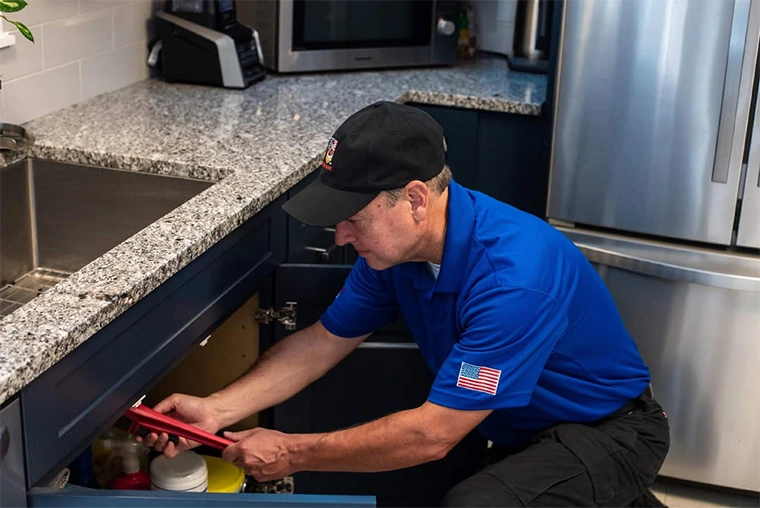
If plunging does not solve the problem, then it is time to grab the snake and go to work under your sink. This involves removing the sink trap with a pipe wrench, but for a large, threaded coupling that is used on PVC plastic traps, you can just unscrew it by hand. With the trap removed, see if there water in it, and then empty it into a bucket. Check if the cause of the clog is in the trap, and if not, remove the horizontal trap arm protruding from the stub-out on the wall to allow yourself to feed the auger cable into it until you feel resistance. Pull out about 18 inches of the cable, and then tighten the lock screw. Crank its handle clockwise and push the cable forward, driving it farther down the pipeline. Repeat this process until you break through the blockage.
If you eventually feel the cable bogging down or catching on something, turn the auger’s crank counterclockwise and pull back. Once the cable is clear, crank it up again and push forward. You can then retrieve the cable and place back trap arm and trap. Run some hot water to see if your sink is already draining properly. If it does not, some debris from the original clog might still be settling into a loose blockage. You can clear it up by filling the sink with hot water and then plunging. End things up by flushing with more hot water.
When working on a clogged sink drain, wear the appropriate safety gear and follow proper instructions when using the tools. Also, observe caution when clearing clogs in older pipes. If you are concerned about these issues or cannot clear a clog, it is best to contact the professionals.
To lessen the chances of having a sink drain clog, avoid putting grease, coffee grounds or any material that can solidify or clump in the sink drain. If you have a disposal unit, regularly run plenty of cold water to flush any particles down the pipe. You can also consider using a treatment for drain maintenance, but make sure it is suitable for your system.

$159 See Offer Details (818) 572-9743 Schedule Now $159…
$159 See Offer Details (818) 572-9743 Schedule Now $159…
$159 See Offer Details (818) 572-9743 Schedule Now $159…
$159 See Offer Details (818) 572-9743 Schedule Now $159…
$58/mo See Offer Details (818) 572-9743 Schedule Now $58/mo…
For many people, plumbing is out of sight and therefore out of mind. If you feel that way right now and you want to change things for the better, then you will want to look into a few tips that will help you prevent a nightmare from occurring. A few…
Learn More